
By Dr. Hiral

As a healthcare professional, I often see patients focusing on physical fitness—heart health, weight management, and mobility. While these are vital, we frequently overlook the “command center” of our entire being: the brain. Today, I want to address a growing concern in our high-pressure society—the direct link between chronic stress and cognitive decline.
We often treat stress as a temporary badge of honor or a necessary byproduct of a busy career. However, when stress becomes chronic, your body is flooded with cortisol. Over time, high levels of this hormone can actually wear away the hippocampus—the part of the brain responsible for memory and learning.
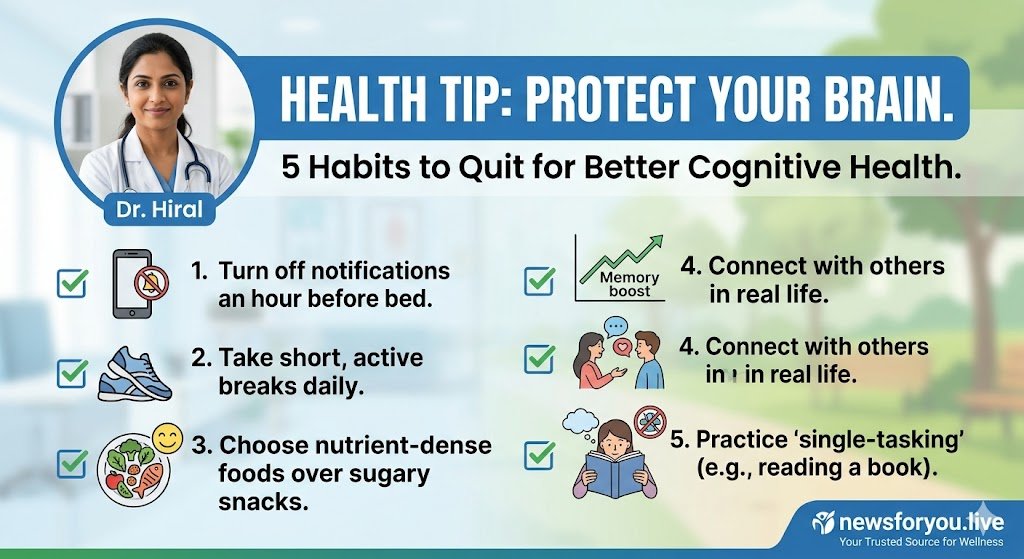
It isn’t just the “big” stressors that do the damage; it’s the daily habits we’ve normalized that silently erode our brain health. Here are five daily habits you should reconsider starting today:
1. The Myth of Productive Multitasking
Many of us pride ourselves on doing five things at once. In reality, the brain doesn’t “multitask”—it switches focus rapidly, which increases “switch cost” and elevates stress hormones. This constant fragmentation makes it harder to form deep memories and reduces your attention span over time.
2. Digital Overstimulation Before Bed
Checking your emails or scrolling through news feeds late at night does more than just keep you awake. The blue light suppresses melatonin, but the “information hit” keeps your brain in a state of high alert. Without deep, restorative sleep, your brain cannot perform its “glymphatic clearance”—the literal washing away of neurotoxic waste.
3. Sedentary “Screen Time” Fatigue
Physical inactivity is a cognitive killer. Movement increases Brain-Derived Neurotrophic Factor (BDNF), a protein that acts like “Miracle-Gro” for your brain cells. When we sit for hours under high-stress conditions without movement, we deprive our brain of the oxygen and nutrients it needs to stay sharp.
4. Over-Reliance on Convenience Foods
Under stress, we reach for high-sugar, highly processed “comfort” foods. These cause spikes in blood sugar that lead to neuroinflammation. A brain that is constantly inflamed is a brain that is at higher risk for early cognitive decline and brain fog.
5. Social Isolation in a Connected World
You can have thousands of followers and still be “socially isolated.” Real-world human connection is a complex cognitive task that keeps the brain engaged. Withdrawing into digital silos when stressed removes the emotional support and mental stimulation required to keep our neural pathways flexible.
The Prescription:
Start small. Choose one habit to change this week. Turn off your notifications an hour before bed, or take a 10-minute walk between meetings. Your future self—and your memory—will thank you.
Editorial Notes
- Target Audience: Readers of newsforyou.live looking for actionable health advice and wellness tips.