
By Dharmesh Prajapati
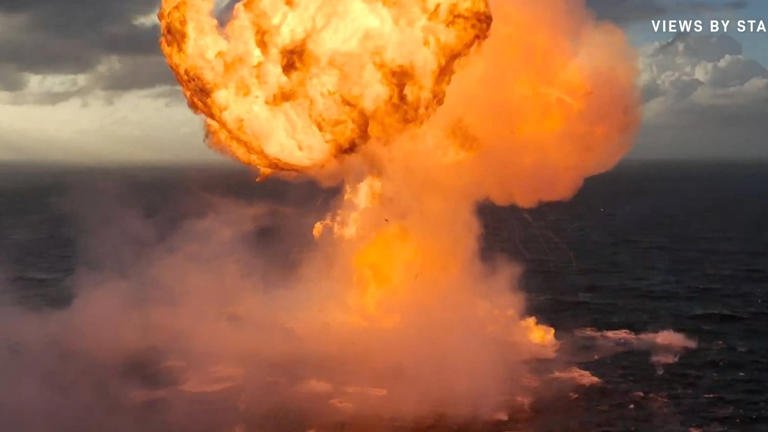
The dramatic journey of SpaceX’s Starship during its high-altitude flight tests has consistently provided some of the most jaw-dropping visuals in modern aerospace history. A recurring theme across multiple test flights—such as the historic Integrated Flight Test 4 (IFT-4)—is the final, fiery spectacular of the spacecraft’s controlled splashdown.
During these test phases, the primary goal for the upper stage Starship is to survive the brutal plasma fields of atmospheric re-entry, execute a precise flip maneuver, fire its Raptor engines to simulate a vertical landing, and safely touch down over the water in the Indian Ocean.
The Mechanics of a “Splashdown Explosion”
When viewers watch Starship make its final descent, the sequence unfolds with extreme precision before a sudden, spectacular burst:
- The Landing Burn: Starship successfully reignites its central Raptor engines to decelerate from supersonic speeds, stabilizing into a perfectly vertical orientation just feet above the ocean surface.
- The Water Tip-Over: Because Starship is not meant to be recovered from the water during these specific tests, it hits the water at zero velocity, cuts its engines, and naturally begins to tip over into the sea.
- The Rapid Deflagration: Seconds after making contact with the saltwater and tipping over, the vehicle undergoes a massive explosion.
This explosion is entirely expected. Starship is constructed out of lightweight stainless steel and contains highly pressurized, cryogenic liquid methane and liquid oxygen. The violent structural stress of a 165-foot-tall rocket tipping over into the ocean cracks the internal propellant tanks. When these volatile gases mix and touch the still-white-hot engine components or residual ignition sources, they instantly combust into a massive fireball.
Watch the Footage
Because external news agencies and tracking planes do not stream live from the remote, uninhabited zones of the Indian Ocean, the definitive, high-definition footage of these water landings comes directly from SpaceX’s internal engineering cameras, broadcast via their official channels.
The full flight replay, including the spectacular re-entry plasma tracking and the final Indian Ocean splashdown sequence, can be viewed directly on SpaceX’s official media platform:
- Watch the Official Stream: You can view the fully archived broadcast, complete with live telemetry and multiple camera angles of the final touchdown, directly on SpaceX’s Official Flight 4 Replay on X.
An Engineering Victory, Not a Failure
While a massive fireball looks like a catastrophe to the untrained eye, Elon Musk and the SpaceX engineering team categorized these results as a massive success. The primary objective of these splashdowns is to prove that the flight computer can successfully navigate, guide, and control a heavy-lift vehicle through maximum aerodynamic pressure and re-entry heat to hit a pinpoint target in the ocean.
Once the vertical water landing is completed successfully, the destruction of the prototype upon tipping over yields no negative consequences, as the vehicle had already transmitted all critical flight data back to engineers in real-time.