
By Dharmesh Prajapati
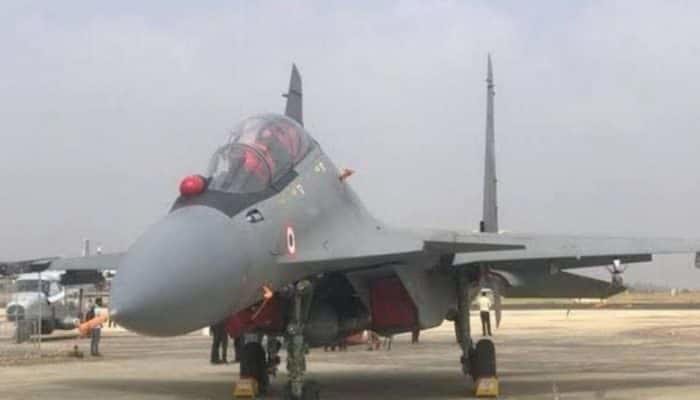
New Delhi: India has begun upgrading its Su-30MKI fighter jets with advanced anti-jamming and anti-spoofing GPS antennas. The Ministry of Defence (MoD) has issued a Request for Proposal to Indian companies for upgrading 258 aircraft, which form the backbone of the Indian Air Force (IAF).
The new system is meant to improve navigation in contested electronic environments and will support multiple satellite networks, including India’s NavIC, along with GPS, GLONASS, BeiDou, Galileo and GAGAN. Even in cases where enemy forces attempt electronic disruption, the aircraft will be able to maintain reliable positioning support for pilots.
While the upgrade opens a new phase in India’s defence technology push, the story of how the Su-30MKI entered Indian service goes back to a very different situation in the 1990s, when Russia’s aviation industry was struggling to survive.
Moscow’s aviation sector in crisis
After the collapse of the Soviet Union, Russia went through a political and economic transition. The once massive USSR defence ecosystem broke apart, and industries that depended on state funding were left without stable support. The aviation sector was among the hardest hit. Russian aircraft manufacturers were facing financial stress, and new orders from the military had nearly dried up.
It was during this period that India stepped in as a major partner for Russia’s defence aviation sector.
The turning point in 1994
In 1994, an Indian defence delegation visited Russia and travelled to the Irkutsk aviation plant in Siberia, where Sukhoi was developing the Su-30 fighter aircraft. Indian officials saw strong potential in the platform and believed it could be adapted for advanced operational roles suited to India’s requirements.
Over the next two years, talks and evaluations continued between the two sides. These talks eventually led to an agreement that would define a long-term defence partnership.
On November 30, 1996, India signed a $1.462 billion deal with Sukhoi for 50 Su-30 aircraft. The agreement was structured in stages, with deliveries planned across multiple phases. Each stage included performance improvements and upgrades, allowing the aircraft to evolve over time instead of being delivered as a fixed final product.
The birth of the Su-30MKI
What India received was not a standard export model. The aircraft was customised step by step to meet Indian operational needs. This process eventually led to the development of the Su-30MKI variant, which was built specifically for the IAF.
In 2000, another major agreement was signed under which the Hindustan Aeronautics Limited (HAL) began licensed production of the aircraft in the country. Around 140 jets were built domestically. It was a major step in India’s aircraft manufacturing capability.
The first fully developed Su-30MKI entered service with the IAF in 2004. By 2007, India placed an additional order for 40 aircraft to further increase the fleet.
Continuous upgrades over the years
The Su-30MKI fleet has undergone multiple upgrades over time to keep pace with evolving requirements. These include canard foreplanes for improved manoeuvrability, thrust vectoring for better flight control and advanced radar systems such as the Russian N011-M passive electronically scanned array radar.
The aircraft also integrates a mix of avionics systems sourced from Russia, France, Israel and India, making it one of the more customised fighter platforms in India’s arsenal.
A partnership driven by timing
The Su-30MKI story is rooted in a moment when Russia’s defence industry needed external support, and India was looking for a long-range multi-role fighter platform. The 1996 agreement not only helped the country strengthen its air combat capability but also gave Russia’s aviation sector a much-needed export lifeline during a difficult economic phase.
Today, India is upgrading the same fleet again, and the aircraft is still being improved to match new technology needs. This partnership started during a time when the world was going through major changes.