
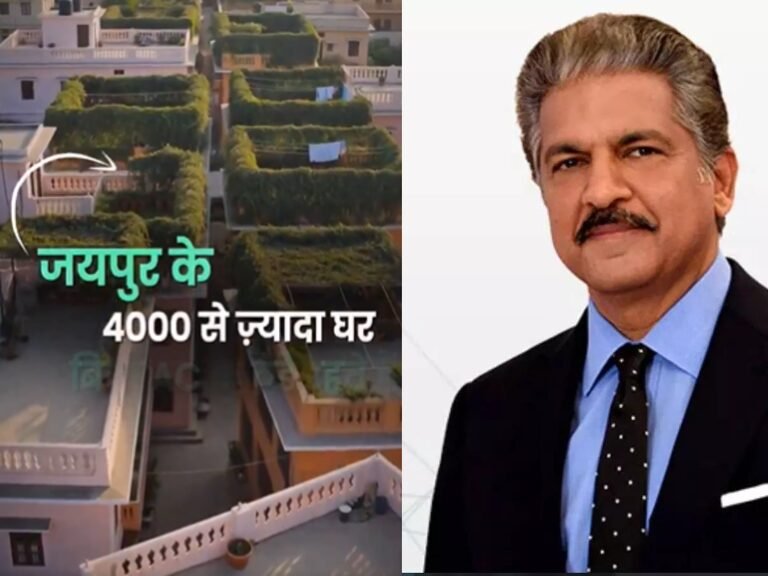
As North India swelters under unrelenting 40°C+ heatwaves, urban households are desperately searching for relief. While the standard response has been to crank up the air conditioning—sending electricity bills soaring and worsening the urban heat island effect—an ingenious, green revolution is taking root in Rajasthan.
Industrialist Anand Mahindra recently took to X (formerly Twitter) to spotlight a brilliant rooftop farming technique emerging from Jaipur. Developed by a local startup named Living Green Organics, this system allows families to naturally drop their indoor temperatures while simultaneously growing their own organic food.
Mahindra praised the initiative as a textbook example of the “adaptive thinking” that will define the future of urban India.
Traditionally, bare concrete rooftops act as massive heat sinks during peak summer months, absorbing intense solar radiation during the day and radiating that heat downward into living spaces at night.
The Jaipur technique completely flips this script. By installing lightweight, portable modular farming systems across unused terraces, residents create a natural barrier. The science behind it is beautifully simple:
- Direct Shade: A thick canopy of vegetable plants blocks sunlight from directly hitting and heating the concrete slab.
- Evapotranspiration: As plants breathe, they release moisture into the surrounding air. This process naturally cools down the rooftop’s micro-environment, preventing heavy heat from penetrating into the rooms below.
The Result: Over 4,000 families across various Indian cities have already adopted this setup, reporting noticeably cooler indoor interiors and a massive reduction in their monthly power bills.
How the Innovation Works
What makes this technique truly revolutionary—and what caught Anand Mahindra’s eye—is that it bypasses the traditional roadblocks of urban terrace gardening (like heavy mud and water leakage).
- Soil-less Medium: Instead of heavy, water-retaining soil that puts structural stress on old buildings, the system uses a high-density, nutrient-rich, ultra-lightweight organic medium.
- Leak-Proof Framework: Portable beds are constructed out of high-density polyethylene (HDPE) containers featuring built-in drainage and water recycling. This ensures that water circulates efficiently without ever seeping into the building’s roof structure.
- Vertical Integration: To maximize limited urban space, the setup utilizes vertical green walls integrated with efficient drip irrigation to conserve water while scaling up leaf cover.
A Sustainable Blueprint for India’s Future
The response to Mahindra’s post highlights a massive shift in how urban communities view climate change. Instead of relying solely on energy-guzzling cooling appliances, the Jaipur model offers a circular solution that solves two problems at once: extreme heat and urban food security.
Families are now harvesting fresh, pesticide-free gourds, tomatoes, cabbages, and herbs directly from their roofs, all while creating a breathable, shaded sanctuary right above their heads.
As Indian cities prepare for longer, more intense summer cycles, simple, community-driven marvels like this Jaipur technique prove that nature-based design is often the smartest tech we have.