
By Dharmesh Prajapati for newsforyou.live
Ahmedabad knows heat.
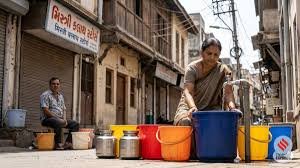
It arrives every year like a familiar but unforgiving guest, settling over concrete terraces, traffic-clogged roads, and crowded housing societies with relentless intensity. But this summer, for thousands of residents across the city, the rising temperature has collided with something even more alarming than the heat itself: water uncertainty.
A planned 10-day disruption in water supply has triggered concern, frustration, and anxiety across parts of Ahmedabad already battling soaring temperatures touching dangerous levels.
For many families, the announcement was more than a civic inconvenience. It was a reminder of how fragile urban comfort becomes when the most basic necessity suddenly feels rationed.
In apartment complexes across the city, overhead tanks are now monitored like countdown clocks. Residents are storing water in buckets, drums, utensils, and plastic containers. Housing societies are recalculating usage patterns. Tanker operators are witnessing rising demand while middle-class households brace for days of careful consumption.
The timing could hardly be worse.
Ahmedabad’s summer heat has intensified sharply in recent years due to rapid urbanization, shrinking green cover, and expanding concrete infrastructure. The city often experiences heat-island effects where temperatures remain trapped long after sunset, turning nights into slow-burning furnaces.
In such conditions, water is not merely utility infrastructure.
It becomes survival infrastructure.
The disruption, reportedly linked to critical maintenance and pipeline-related works, may be temporary on paper. But its impact exposes deeper long-term questions about urban planning, climate resilience, and water management in one of Gujarat’s fastest-growing cities.
Ahmedabad’s growth story has been remarkable. Flyovers rise quickly. Riverfronts sparkle under evening lights. New townships stretch farther toward the edges of the city each year. Yet beneath the visible expansion lies a growing pressure on water systems struggling to match the pace of urban demand.
And summer exposes every crack.
For poorer neighborhoods and informal settlements, the crisis hits harder. Families without storage capacity or reliable backup systems often spend hours waiting for municipal supply or private tankers. Every delayed water cycle disrupts cooking, sanitation, hygiene, and daily work routines.
Even schools, hospitals, restaurants, and small businesses begin feeling the pressure when supply interruptions extend beyond a few days.
Ironically, Ahmedabad stands beside the Sabarmati River, a symbol of urban transformation and civic pride. Yet modern cities cannot survive on appearance alone. Decorative waterfronts and infrastructure projects mean little if households fear turning on taps during peak summer.
Climate change is making these challenges more urgent.
Experts increasingly warn that Indian cities will face more frequent water stress events due to rising temperatures, erratic rainfall, groundwater depletion, and expanding populations. Urban India’s future may not only be shaped by how cities grow upward, but by whether water can continue flowing beneath them.
For now, Ahmedabad waits.
Residents adjust routines. Tankers rumble through neighborhoods like moving lifelines. Children are told to use less water. Societies circulate WhatsApp advisories requesting restraint. The city continues functioning, but more cautiously, more consciously.
Perhaps that is the real lesson hidden inside this 10-day disruption.
Water scarcity rarely arrives dramatically at first. It enters quietly through reduced timings, weak pressure, delayed supply schedules, and growing dependence on backup systems. By the time panic appears, the deeper crisis has already been building for years.
This summer, Ahmedabad is not just facing heat.
It is confronting the uncomfortable reality that in the cities of tomorrow, water may become more precious than the skylines built around it.