
By Dharmesh Prajapati
India-US Ties: The occasion was the early 250th anniversary celebration of the US Declaration of Independence in Delhi, but US President Donald Trump’s message from Washington was unmistakable. On a phone call patch-through during the event, President Trump was heard saying that he loves Prime Minister Narendra Modi, whom he described as a “great friend.” Trump’s remarks came amid US Secretary of State Marco Rubio’s four-day visit to India, during which Rubio extended an official invitation on behalf of the White House for PM Modi to visit Washington. India, however, was quick to remind the delegation that the US must not harbor illusions regarding the fight against terror and Washington’s recent pivot toward Pakistan.4
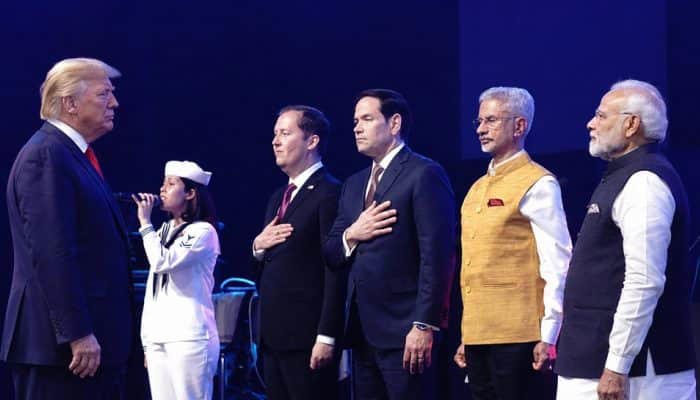
The event Rubio attended at the US Embassy in New Delhi on May 24 was the embassy’s annual Independence Day reception, scaled up early to mark the upcoming US ‘Semiquincentennial’ (250th anniversary) of American independence. While the official July 4 milestone is weeks away, the embassy advanced its celebration during Rubio’s visit to turn the event into a grand stage for mending fractured India-US ties. Diplomatic observers view Rubio’s trip as a critical damage-control mission, arriving at a time when the Trump administration’s heavy pivot toward Pakistan has come at India’s expense.
Public Romance vs. Diplomatic Realism
Addressing the Indian audience via the call, Trump said, “I just wanna say you are great. We have never been closer to India, and India can count on me and our country 100 per cent. If they need any help, they know where to call. They call right here. We are doing well. We are setting records. We have a record economy, a record stock market.” Further courting New Delhi, the US President added, “Anything India wants, they will get. I am a big, big fan of Prime Minister Modi.”
However, the counter-message from India was unyielding: supporting Pakistan at the cost of Indian security interests remains an unacceptable move. Addressing the gathering on the US Embassy grounds, India’s External Affairs Minister Dr. S. Jaishankar emphasized that both nations must maintain absolute clarity regarding zero tolerance for terrorism. Jaishankar noted that while both nations share a common interest in de-risking the global economy and providing the world with more choices, security cooperation cannot be compromised. The zero-tolerance message—delivered directly from the heart of the US diplomatic mission in New Delhi—was India’s stark reminder that Trump cannot keep General Asim Munir on the White House’s priority list while Islamabad continues to sponsor cross-border terrorism against India.
Rubio’s Tightrope Walk
While New Delhi experienced soaring summer temperatures, US Secretary of State Marco Rubio faced an equally intense diplomatic climate. Rubio, who had previously been singing praises for Pakistan and its Field Marshal Asim Munir, was met with bare-minimum protocol when he landed in New Delhi. India has been exercising immense strategic restraint as Washington officials consistently placated Pakistan while making statements that rankled New Delhi.
Rubio was also caught off guard when journalists pressed him on Trump’s apparent endorsement of racist online comments targeted at Indians. Deflecting the controversy, Rubio framed the US as an inherently welcoming nation, remarking that “every country has some ‘stupid’ people” who make such comments.
‘Their issue with PAK is different’: Rubio on India’s concern over Islamabad’s role in US-Iran talks
As the president said, he’s not in a hurry.
Recognising that New Delhi is deeply dissatisfied with the trajectory of ties under Trump 2.0, the White House deployed Rubio to get the strategic partnership back on track. Trump’s effusive phone call was a calculated component of that effort. While the President showered praise on Modi, Rubio worked the diplomatic front to explicitly downplay Washington’s relationship with Islamabad, characterizing it as strictly “tactical” and insisting it would “never come at the expense of a strategic alliance with India.”
The Deeper Strain: Economic and People-to-People Ties
The current strain in India-US relations goes far beyond the Pakistan factor. Key friction points have steadily bled from trade into critical people-to-people channels:
Immigration & Visas: The Trump administration’s recent tightening of H-1B regulations and a disruptive mandate forcing Green Card applicants to return to their home countries for paperwork processing have deeply frustrated Indian IT professionals and the tech sector.
Trade & Economics: Stiff American tariffs and aggressive trade sanctions have stalled a wider India-US trade agreement, subsequently delaying the scheduling of the long-overdue Quad Summit in India.
The Pakistan Factor: While India views Pakistan as a state sponsor of terror, the US has spent the last few months heavily relying on Pakistan’s Army Chief, Field Marshal Asim Munir, to mediate and message during the US-Iran war.
Why Trump is Pivoting Back to India
Trump had previously showered lavish praise on Pakistan, PM Shehbaz Sharif, and General Munir on multiple occasions, purely because Islamabad was serving as the White House’s primary backchannel for talks with Tehran. With the Iran crisis nearing a resolution and the issue largely settled, India is once again the primary focus. President Trump has announced that an Iran peace deal is now “largely negotiated,” meaning the US no longer requires Pakistan’s urgent diplomatic heavy lifting.
Consequently, Washington is pivoting straight back to India to ensure safe, unimpeded maritime commerce across vital Indo-Pacific and Gulf shipping lanes, while attempting to put the momentum back into the Quad alliance. Ultimately, this shift validates what geopolitical experts have long argued: the United States tends to treat Pakistan as a short-term tactical ally—used like a tissue paper and discarded once immediate objectives are achieved—whereas India remains America’s indispensable, long-term strategic partner.