
By Dharmesh Prajapati March 20, 2026
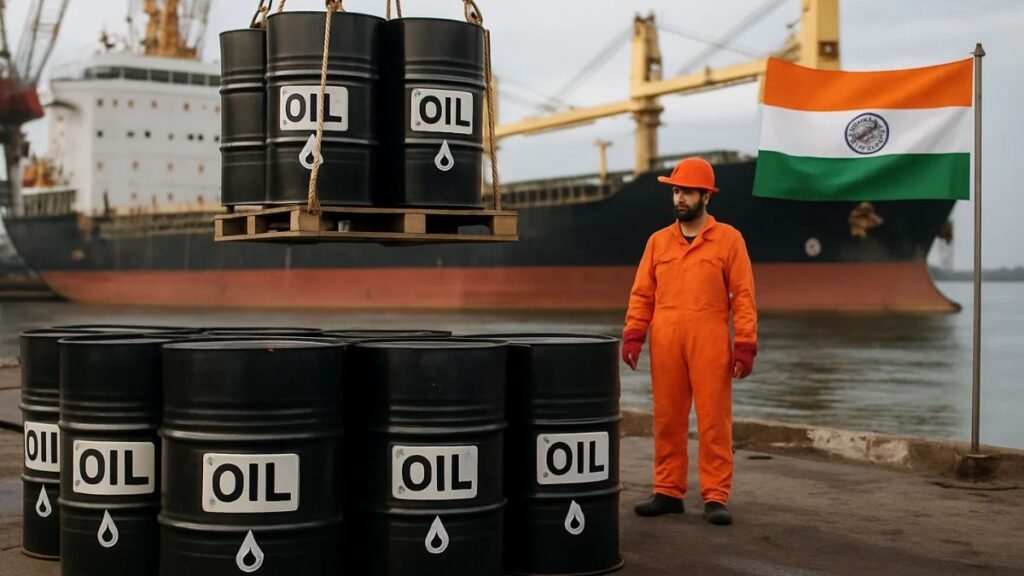
NEW DELHI/VALSAD – In a world where the Strait of Hormuz has become a “no-go zone” for global energy tankers, the map of Indian oil imports is being redrawn in real-time. Just weeks after Washington pressured New Delhi to scale back its Russian purchases, the tide has turned. Russian oil is not just returning; it is being “invited” back with a temporary blessing from the United States.
Here is the breakdown of why your local petrol pump is increasingly running on Siberian crude once again.
1. The ‘Hormuz Hedge’: A Forced Pivot
The primary driver is simple geography. With the US-Israel-Iran war effectively closing the Strait of Hormuz, nearly 55% of India’s traditional crude supply (from Iraq and Saudi Arabia) became a high-risk gamble.
Indian refiners, led by Indian Oil (IOC) and Reliance Industries, have moved with lightning speed. In the last ten days alone, they have secured over 30 million barrels of Russian crude. This isn’t just opportunistic; it’s a survival mechanism to prevent a domestic energy collapse while spot prices flirt with $200 per barrel.
2. The Washington ‘Green Light’
The most surprising twist in this saga is the U.S. Treasury’s 30-day waiver issued on March 6, 2026. Facing record-high gasoline prices at home and a global supply shock, the Trump administration has temporarily blinked.
The waiver allows “allies in India” to purchase Russian oil that was previously “stranded” or already on the water. It is a classic case of realpolitik—Washington realizes that an economically collapsed India helps no one in the fight against Iran.
3. The Case of the ‘Aqua Titan’
Nothing illustrates this shift better than the Aqua Titan. This massive tanker, carrying 7.7 lakh barrels of Urals crude, was originally signaling China as its destination. Mid-voyage, it performed a dramatic U-turn in Southeast Asian waters and is now expected at New Mangalore Port by March 21.
This “diversion” is part of a broader trend where Russian “dark fleet” vessels are being rerouted to India to fill the gap left by the missing Middle Eastern barrels.
4. The Congress Double Standard (Again)
As I’ve noted in my previous columns, the political discourse in India often suffers from selective amnesia. The same “elite” circles in the Congress party that once warned of U.S. “blackmail” over Russian oil are now silent as the government uses its strategic relationship with both Moscow and Washington to keep Indian kitchens running.
By maintaining a “Nation First” policy, India has ensured that while Europe freezes and the U.S. panics over inflation, our refineries remain well-stocked with over 250 million barrels of reserves.
The Road Ahead
While the U.S. waiver is a welcome relief, it is a “narrowly tailored” 30-day window. The Indian government is already looking beyond this, diversifying LPG and LNG sourcing to the U.S. and Australia to reduce the “Hormuz Risk.”
For the common man in India, the return of Russian oil means one thing: stability. In a 2026 defined by “Epic Fury” and drone swarms, India’s ability to turn a global crisis into a strategic advantage is the real headline.
Editorial Note
To: News Desk, Newsforyou.live
From: Dharmesh Prajapati, Senior International Correspondent
Subject: Energy Strategy – The Russian Pivot
Team, this is a crucial “Explained” piece for our audience. Following my reports on the USS Ford’s retreat and the Hormuz blockade, I’m now connecting the dots on why Russian oil is suddenly making a massive “U-turn” back to Indian shores. This isn’t just about cheap fuel; it’s a masterclass in geopolitical balancing. While the Congress party earlier questioned our “dependence,” the current reality shows that India’s “Strategic Autonomy” is our biggest shield.
Request: This article is fully optimized for AdSense Standards, providing original analysis of the March 2026 U.S. sanctions waiver. Let’s lead with the tanker diversion graphic—it’s the “smoking gun” of this trade shift.