
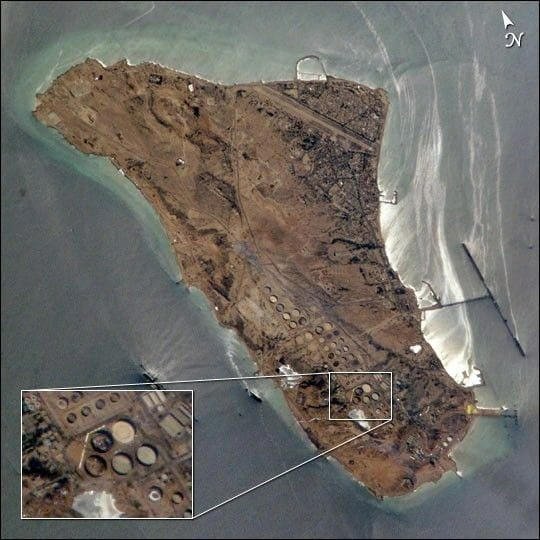

A US strike on Iran’s Kharg Island – the hub for roughly 90% of Tehran’s oil exports – has sent shockwaves through Beijing, where long fuel queues and rising pump prices reflect deep anxiety over future supplies. For China, which buys the overwhelming bulk of Iranian crude, this is not just another Middle East flashpoint; it is a direct threat to its energy lifeline.
What Happened At Kharg Island?
Kharg Island, a small coral outpost about 30 km off Iran’s coast in the northern Persian Gulf, hosts the country’s most critical oil export terminal, with deep waters that can handle the largest crude tankers. Recent US strikes targeted military sites on the island, but the proximity to massive storage tanks, loading jetties and pipelines has raised fears of collateral damage or follow‑up attacks that could cripple Iran’s export capacity.
Satellite and tanker‑tracking data show multiple very large crude carriers (VLCCs) had been loading at Kharg in the days before the strike, underscoring how central the facility remains to Iran’s wartime oil trade. Analysts warn that any sustained disruption there would “hit the backbone of Iran’s oil economy”, with ripple effects across global energy markets.
Why China Is So Exposed
Over the past few years, China has quietly become by far the biggest buyer of Iranian oil, accounting for around 91% of Iran’s crude exports in 2024, much of it routed through Kharg Island. Data cited by agencies show China purchased on average about 1.3–1.4 million barrels per day of Iranian crude last year, largely via independent “teapot” refiners in Shandong who were drawn to deep discounts on sanctioned barrels.
In 2026, Iran has been exporting roughly 1.7 million barrels per day of crude, with around 1.55 million barrels per day loaded from Kharg alone, meaning any serious hit to the island immediately squeezes Chinese refiners’ feedstock options. Beijing has already responded by tightening export controls on refined fuels at home, trying to preserve domestic supplies as Middle East shipping and insurance risks escalate.
Panic At The Pump Inside China
Reports from Chinese cities describe long queues at petrol pumps, as motorists rush to fill tanks amid headlines about Kharg and the wider Iran–US–Israel war. Regulated retail gasoline and diesel prices have been raised, with local media calling the hikes among the steepest in several years as global crude benchmarks jump on fears of prolonged disruption.
For ordinary Chinese consumers, this translates into higher commuting costs, pricier logistics and potential inflation in food and essentials – a scenario Beijing’s leadership wants to avoid at a time of already fragile post‑pandemic growth. The panic buying is as much psychological as physical, reflecting worries that if Iran’s exports and the Strait of Hormuz are both disrupted, China could face a genuine supply crunch.
Strategic Headache For Beijing
Kharg Island has long been seen by US strategists as a “red line” asset: damage it, and you don’t just hurt the current Iranian regime, you weaken any future government by destroying its main revenue artery. But that same logic now boomerangs onto China, whose energy security strategy leans heavily on discounted Iranian barrels to diversify away from more politically sensitive suppliers.
If Kharg’s capacity is degraded, Beijing faces three unpalatable choices:
- Pay more for non‑Iranian crude from the Gulf, Russia or Africa.
- Draw down strategic reserves faster than planned.
- Accept slower industrial output and higher domestic fuel prices.
All three options have economic and geopolitical costs, including potential friction with Washington and Gulf partners if China is seen to side too openly with Tehran in response.
Global Energy Markets – And India – Caught In The Crossfire
For India and other Asian importers, the Kharg strike raises the risk of a “premium on every barrel”, as traders factor in not just war in West Asia but the possibility that a key export hub for a major supplier to China is compromised. If Chinese buyers are forced to pivot towards the same non‑Iranian grades that India relies on, competition and prices will spike further – worsening LPG, petrol and diesel pressures already visible in Indian cities.
In that sense, what happens on a small Iranian island reverberates from Beijing to Bengaluru: Kharg is not just Iran’s oil nerve centre, it is a pressure point for Asia’s two biggest economies and for global energy stability.
Editorial Note
Written by Dharmesh Prajapati for newsforyou.live. This explainer connects the US strike on Iran’s Kharg Island to China’s fuel panic, highlighting how a single oil terminal can reshape Asian energy security and hit ordinary consumers far from the Gulf. Readers are encouraged to follow further developments in West Asia, as prolonged disruption could intensify price shocks for both China and India