
By Dharmesh Prajapati March 19, 2026
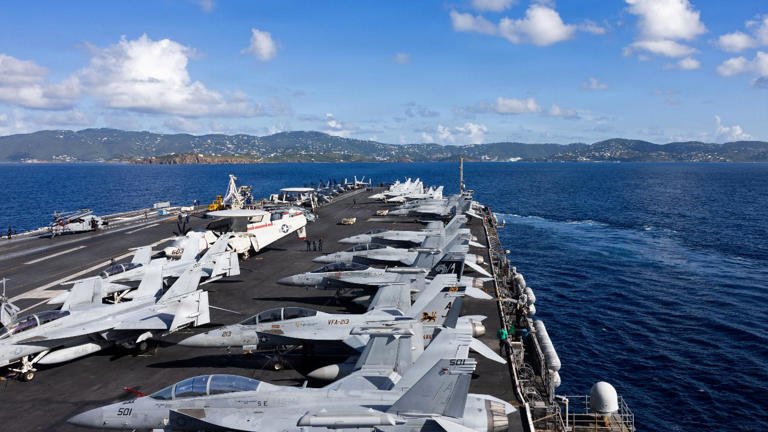
RED SEA/SOUDA BAY – The crown jewel of American naval power, the nuclear-powered USS Gerald R. Ford (CVN-78), is officially leaving the frontlines of “Operation Epic Fury.” Following a devastating 30-hour non-combat fire that gutted living quarters and injured hundreds, the $13 billion behemoth is now steaming toward Souda Bay, Crete, for emergency repairs.
While the Pentagon insists the ship’s propulsion is intact, the withdrawal of the world’s largest aircraft carrier during the height of the US-Iran conflict sends a powerful message to the world: even a superpower has a breaking point.
The 30-Hour Battle Below Decks
The incident, which began in the ship’s main laundry facility on March 12, was far more serious than initially reported. Smoke and flames surged through the ventilation shafts of the 1,100-foot vessel, turning the ultra-modern carrier into a soot-filled maze.
- The Human Toll: Nearly 200 sailors were treated for smoke inhalation, with one service member medically evacuated.
- The “Bedless” Crew: The blaze destroyed the sleeping berths of over 600 sailors. In a shocking lapse for a “state-of-the-art” vessel, 13% of the crew are currently sleeping on floors and mess-hall tables.
- The Logistics Nightmare: With the laundry systems destroyed, the Navy has been forced to “crowdsource” 1,000 mattresses and thousands of uniforms from other ships just to keep the crew functional.
The “Overextension Trap”
The fire is not just an accident; it is a symptom of a ship—and a crew—pushed beyond human limits. The Ford has been at sea for nearly 10 months, spanning the Mediterranean, a blockade of Venezuela in the Caribbean, and now the high-intensity strikes against Iran.
By pushing for a “record-breaking” deployment, the Trump administration has ignored the basic laws of naval maintenance. As I reported previously, “Ships get tired too.” The persistent plumbing failures (affecting 650 toilets) and now this catastrophic fire suggest that the Ford was never ready for a sustained war of attrition.
A Strategic Gap in the Red Sea
With the Ford heading to Greece, a massive vacuum opens in the U.S. strike capability. While the USS George H.W. Bush is being rushed to replace it, the transition period is a window of opportunity for Iran’s IRGC, who have already labeled the Ford’s logistics centers as “active targets.”
The “Dual Standard” here is clear: Washington demands its allies “share the burden” of the war, yet its own primary asset is forced to retreat not because of an enemy missile, but because it is literally falling apart under the weight of its own deployment.
What This Means for Global Markets
As the “Limping Leviathan” moves toward Crete, the security of the Red Sea shipping lanes becomes even more precarious. Without the Ford’s 75+ aircraft providing a constant “eye in the sky,” the threat from Iranian Shahed drones to commercial tankers increases exponentially.
For our readers in India and the Gulf, this is a sign that the “swift victory” promised by the U.S. is dissolving into a logistical nightmare. The Ford was supposed to be the future of warfare; today, it is a $13 billion reminder that no technology can replace the need for rest, maintenance, and realistic diplomacy.
Editorial Note
To: News Desk, Newsforyou.live
From: Dharmesh Prajapati, Senior International Correspondent
Subject: Breaking Military Report – The Limping Leviathan
Team, this is the story the Pentagon is trying to downplay. While official statements emphasize that the USS Gerald R. Ford remains “fully operational,” the reality on the ground—or rather, on the water—is one of severe logistical and human strain. A 30-hour blaze on the world’s most expensive warship is not a “minor incident.” I’ve framed this as a symptom of the “Overextension Trap” that President Trump’s administration has fallen into.
Request: We need to use the “Carrier Comparison” graphic to show the sheer scale of the Ford and why a fire in its “laundry” is a systemic threat to a crew of 4,500.