
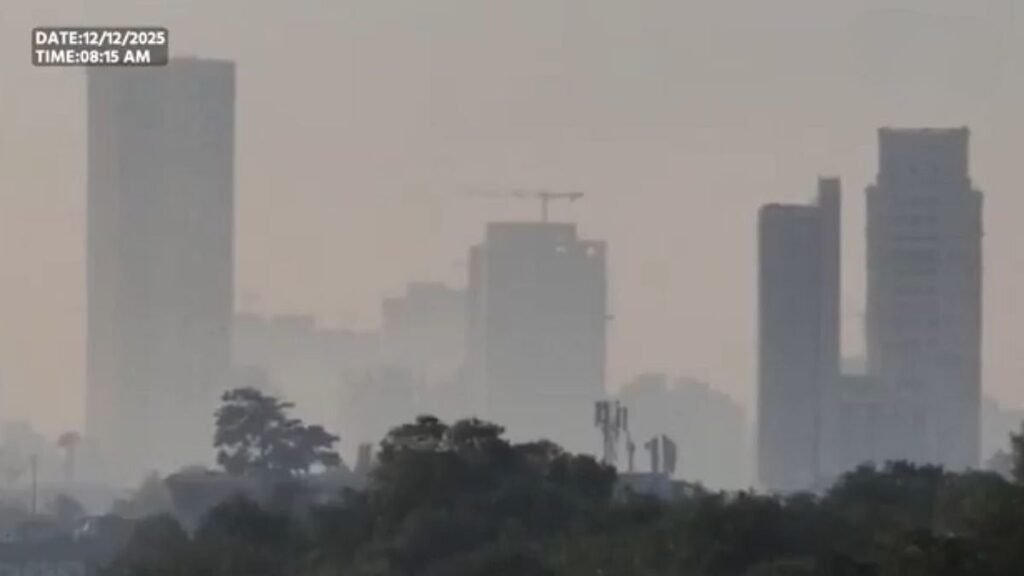
Mumbai: Mumbai experienced a refreshing winter nip on Friday morning as clear skies, cooler winds and mild temperatures offered residents a pleasant start to the day. The India Meteorological Department (IMD) reported that the temperature was likely to hover between a minimum of around 15°C and a maximum of 32°C, marking one of the season’s more comfortable days. However, the seemingly picture-perfect morning masked a persistent environmental challenge: the city’s steadily deteriorating air quality.
Mumbai, Maharashtra: Visuals from the Bandra area show unhealthy air quality, with AQI levels recorded at around 181 pic.twitter.com/J5XnPMY0JN
— IANS (@ians_india) December 12, 2025
Despite the pleasant weather, a thin layer of haze settled over Mumbai, signalling that pollution levels continue to be a concern. According to data from AQI.in, the city’s Air Quality Index (AQI) stood at 148 early Friday morning, categorised as ‘poor’. While this reading is slightly better than the alarming spikes seen in recent weeks, it remains harmful, especially for children, the elderly and those with respiratory issues.
#WATCH | Maharashtra | A thin layer of fog lingers in the air as AQI in the Bandra Kurla Complex area of Mumbai is recorded at 116, categorised as 'Moderate' as per CPCB. pic.twitter.com/4f8fMGeJyj
— ANI (@ANI) December 12, 2025
Experts attribute the worsening pollution primarily to dust and particulate matter emitted by Mumbai’s massive infrastructure boom. Large-scale government projects, metro corridors, coastal road construction, bridges and extensive road widening, along with rising private construction continue to add significant pollution load into the atmosphere.
Wadala Sees Worst Air Quality
The AQI readings across different areas of the city highlighted stark contrasts. The Wadala Truck Terminal was the worst-hit, recording a staggering AQI of 305, placing it in the ‘severe’ category. Such levels pose health risks even to healthy and active individuals. Mulund West also fared poorly with an AQI of 207, in the ‘unhealthy’ bracket.
Other areas reflected similar patterns. Deonar (200) and Bhandup (187) remained in the ‘poor’ category, while Govandi and Chembur registered AQI levels of 187 and 183, respectively.
Suburban regions performed slightly better but were far from ideal. Parel–Bhoiwada and Kandivali East recorded moderate AQI levels of 73, while Jogeshwari East stood at 95. On the other hand, Charkop (107) and Malad West (117) slid into the ‘poor’ bracket.
For context, an AQI of 0–50 is considered ‘good’, 51–100 ‘moderate’, 101–150 ‘poor’, 151–200 ‘unhealthy’ and anything above 200 ‘hazardous’.
To get details on exclusive and budget-friendly property deals in Mumbai & surrounding regions, do visit: https://budgetproperties.in/