
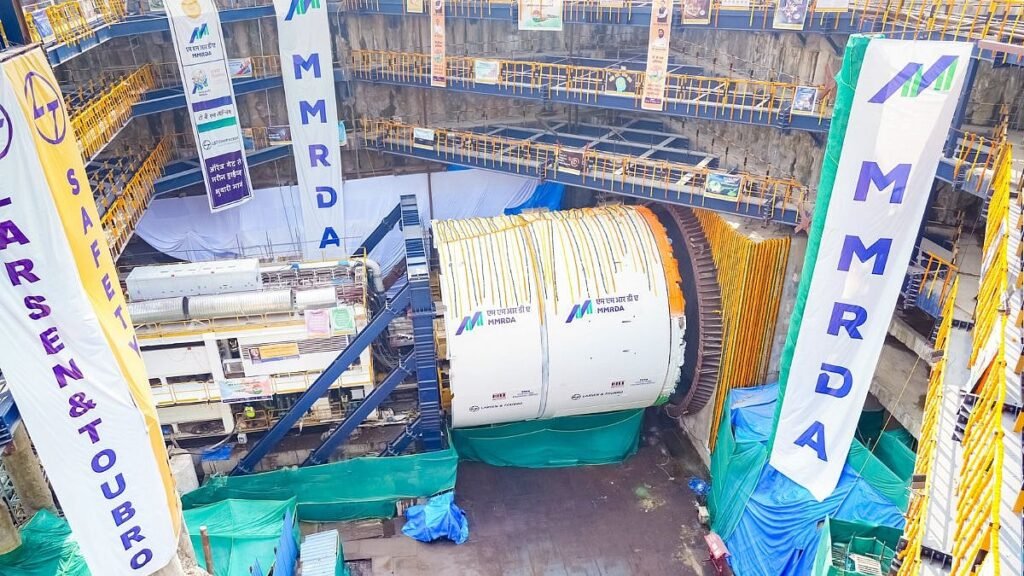
Mumbai: Maharashtra Chief Minister Devendra Fadnavis on Wednesday officially launched the Tunnel Boring Machine (TBM), kicking off tunnelling operations for the ambitious Orange Gate to Marine Drive underground road corridor. The project, estimated at Rs 8,056 crore, is heralded as a vital infrastructure upgrade that aims to dramatically enhance east-west connectivity and provide significant relief from the city’s crippling traffic congestion.
#Maharashtra #DevendraFadnavis #MumbaiInfrastructure #SmartMumbai pic.twitter.com/UcsUAlqPhP
— CMO Maharashtra (@CMOMaharashtra) December 3, 2025
The total corridor length spans approximately 9.239 kilometers, featuring a crucial twin-tube underground tunnel section covering about 6.51 kilometers. Fadnavis described the project as an ‘engineering marvel,’ as it represents India’s first urban tunnel of this complexity, passing beneath some of South Mumbai’s most densely populated areas and critical existing infrastructure.
LIVE | ऑरेंज गेट ते मरीन ड्राईव्ह बोगदा प्रकल्पासाठी 'टनेल बोरिंग मशीन'चा शुभारंभ
स. ११.२५ वा. | ३-१२-२०२५मुंबई.#Maharashtra #MumbaiInfrastructure #MumbaiDevelopment https://t.co/A8yU9PisXf
— Devendra Fadnavis (@Dev_Fadnavis) December 3, 2025
An Underground Engineering Feat
The tunnel’s path is a testament to sophisticated urban planning and engineering. It will dive to depths of up to 52 meters, successfully navigating beneath major transport lines. Crucially, the alignment passes below both the Central and Western Railway tracks and, most challenging, runs approximately 50 meters below the existing underground Mumbai Metro Line 3 (Aqua Line). Furthermore, the planning minimises surface disruption by passing beneath over 700 structures, including numerous heritage properties in areas like Dongri and Khetwadi, showcasing a meticulous design approach.
The dual-tunnel design prioritises safety and capacity. Each tube features two main traffic lanes, each 3.2 meters wide, along with a dedicated 2.5-meter emergency lane. The designed speed limit inside the tunnel is capped at 80 km/h. To ensure maximum safety, cross passages connecting the two tunnels will be constructed every 300 meters, allowing for quick evacuation or emergency response. The facility will also be equipped with fire-resistant systems, modern lighting, mechanized ventilation, and an Intelligent Transport System (ITS) for seamless traffic management.
Get. Set. Go
Mumbai’s underground mobility revolution kicks off today as tunnelling begins on India’s first urban road tunnel, the 9.239 km Orange Gate to Marine Drive Tunnel Project.
Hon’ble Chief Minister of Maharashtra, Shri Devendra Fadnavis, will launch the country’s… pic.twitter.com/WOth2vc7tK
— MMRDA (@MMRDAOfficial) December 3, 2025
Massive Time & Connectivity Gains
Upon its expected completion in about 54 months (around December 2028), the Orange Gate-Marine Drive tunnel is projected to reduce travel time between the Eastern Freeway and Marine Drive by 15 to 20 minutes, bypassing major bottlenecks. This new link will provide a crucial, high-speed connection between the city’s eastern and western suburbs.
Importantly, the corridor integrates with Mumbai’s other mega-projects, linking the Eastern Freeway and MTHL directly to the Coastal Road at Marine Drive. This integration will create an ultra-fast mobility loop that connects the Navi Mumbai International Airport (via the Atal Setu/MTHL) through the Eastern Freeway and across to the Western Suburbs via the Coastal Road and the Bandra-Worli Sea Link, marking a major step toward a truly integrated metropolitan transport network.
To get details on exclusive and budget-friendly property deals in Mumbai & surrounding regions, do visit: https://budgetproperties.in/