
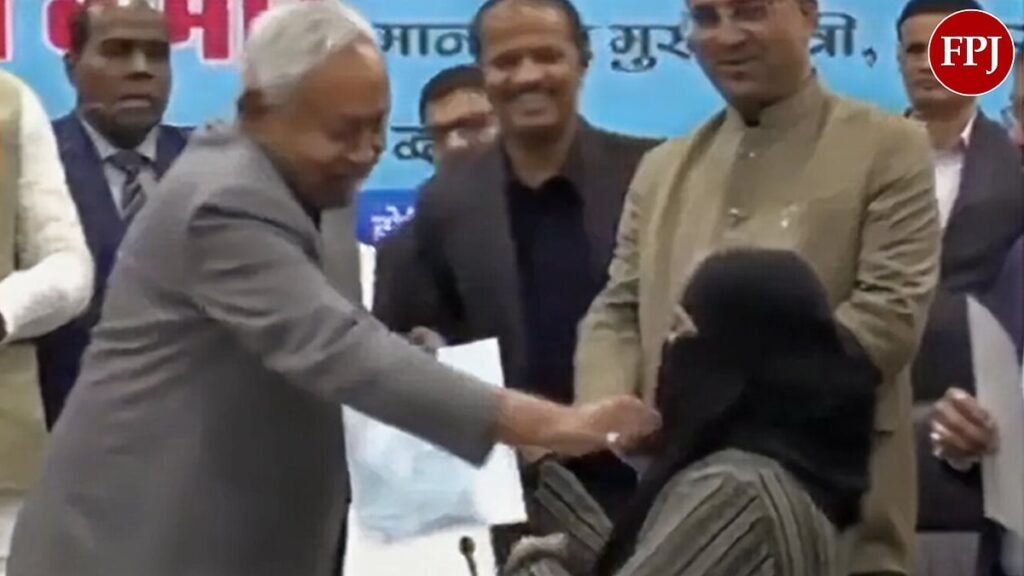
Bihar Chief Minister Nitish Kumar did not cover himself with glory when he forcibly pulled down the veil of a Muslim woman doctor who had stepped forward to receive her appointment letter from him.
The woman was wearing a niqab. Kumar asked her to show her face, but before she could even respond, he stretched out his hand and removed the veil himself. In that single, thoughtless gesture, he crossed a line no man has the right to cross—least of all a Chief Minister on a public stage. What followed made the incident even more disturbing.
The act amounted to a public affront to the woman’s dignity, performed before an audience of men who smiled indulgently instead of objecting. This was not a private lapse of judgement; it was an assertion of power over a woman’s body and choice, played out under the glare of cameras. The symbolism could not have been uglier.
The Chief Minister should have immediately apologised to the woman for his conduct. Instead, he has allowed overzealous defenders to justify the act, some even telling the woman that she could “go to hell” if she objected. Women have the constitutional right to dress as they choose, whether for religious, cultural or personal reasons.
No one—absolutely no one—has the right to touch a woman’s clothing without her consent, let alone remove it. To do so is not just rude or inappropriate; it is a form of disrobing and an assault on personal dignity.
The backlash has been swift and widespread, drawing condemnation from across the country and even abroad. And rightly so. What message does such conduct send? That power entitles men to humiliate women in public. That authority can override consent.
In many areas, even Hindu women instinctively cover their faces with the end of a sari when speaking to strangers. Does that give any man the right to pull it away? Women in India remain victims of deep-rooted patriarchy, forced to live within boundaries fixed by men.
Nitish Kumar’s behaviour exemplifies that mindset. After ruling Bihar for nearly two decades, one would expect greater maturity and sensitivity. Instead, what was on display was crude entitlement. This is not an isolated lapse.
Earlier this year, Kumar made the bizarre and offensive claim that women in Bihar did not wear clothes in the past. On what evidence such a statement was made remains a mystery.
His past attack on Lalu Prasad Yadav—reducing Yadav’s tenure to nothing more than producing children—was not merely political invective but a vulgar, sneering remark that also demeaned Rabri Devi, who served a full term as Chief Minister in her own right. Taken together, these episodes suggest not wisdom born of age, but a troubling decline in judgement.