
Hours after the Agra police discovered his body on February 24 this year, a video Manav Sharma had recorded began circulating online. In it, a visibly distraught Manav addresses the camera with a makeshift noose around his neck—a dupatta looped around the ceiling fan. He begins by speaking to the authorities, naming the police and law enforcement agencies as if they were listening. “The law needs to protect men,” he says, “or there will be no men left to blame.”
All men, he insists, share the same story. His, he says, is no different. He claims to have discovered that his wife, Nikita, would sleep with someone else, but immediately shrugs off the relevance of the supposed betrayal. What matters, he urges, is that someone finally speak about men. “They are so lonely,” he says. At moments, his speech unravels. He apologises to his parents—“Everything will be fine once I go; let me leave!”—and shows cut marks on his arm. “I have always been a quitter,” he says. He scoffs at “law and order”, before turning unexpectedly prescriptive. He urges all men to masturbate, suggesting it may be their only remaining release.
The video ends without resolution. What remains is a man performing his despair for an audience that arrives too late. We see Manav caught between grievance, incoherence and a desperate need to be seen. In 2017, the Mental Healthcare Act decriminalised suicide. In theory, this marked a shift away from punishment and blame. In practice, it has merely displaced culpability. If there is a body, there must still be a killer. That killer is not the law or the state, but an individual—often a woman—identified, tried and sentenced in the court of public opinion.
Manav’s family, television news channels and social media trolls quickly converged on Nikita, accusing her of abetting his suicide. She was soon compelled to release a video of her own. In it, she denies having cheated on him. She says she was in a relationship before her marriage. When Manav discovered this, she alleges, he would beat her while drunk. He had also attempted self-harm and suicide on multiple occasions, she says, and she had saved him three times.
“It isn’t true that men are not heard,” Nikita says in the video. “Please listen to me and my story.”
Nikita’s plea seemingly fell on deaf ears. The coverage that followed Manav’s suicide barely engaged with the mental health demons that had earlier driven him to violence, towards his wife and himself. Even basic facts became slippery. The internet could not agree on whether Manav was 25 or 30. His profession, however—he was a Senior Process Associate at Tata Consultancy Services—quickly became the organising frame through which his death came to be understood.
Observers linked his case to that of Atul Subhash, a 34-year-old software engineer found hanging in his Bengaluru home on December 9, 2024. In the video he left behind, Atul accused his estranged wife, Nikita Singhania, and her family of harassment, extortion and relentless legal pressure. He claimed they had filed multiple criminal cases against him—including under the Dowry Prohibition Act—which he described as false, punitive and financially ruinous. The cumulative weight of litigation, he wrote, had pushed him to the brink, compounded by the fear of losing access to his four-year-old son. Atul hung a placard near him that read, “Justice is Due”.
Online vigilantes reacted to Atul’s and Manav’s deaths with the hashtag #MenToo. Many were quick to point out that men accounted for 72.8 per cent of the 1,71,418 suicides reported in 2023, a statistic repeatedly invoked to slot men as the primary victims of India’s mental health crisis. Responsibility for a large share of these deaths was swiftly pinned on women—on figures like the two Nikitas, both accused by their husbands of mental torture.
What was far less visible in this outrage economy was another number the National Crime Records Bureau had published: 6,156 dowry deaths in 2023. The selective arithmetic of men’s rights activism reveals its own myopia. In foregrounding male suffering only through the lens of accusation, it erases the inner lives of women who continue to bear the everyday, structural and often fatal violence of patriarchy.
Not all the headlines of 2025 were bleak. Four years after Sushant Singh Rajput died by suicide, the Central Bureau of Investigation filed its closure report in October this year. The agency said it had found no evidence that Sushant’s girlfriend, Rhea Chakraborty, had illegally confined or threatened him, or that she had abetted his death. This finding of no foul play should, at the very least, prompt an apology from the television news anchors and social media trolls who led a sustained witch-hunt against Rhea.
But it also forces a reckoning with what was obscured by that frenzy: Sushant himself. Instead of accusing Rhea of sorcery and incarcerating her on tenuous drug-related charges, we might have asked harder, more uncomfortable questions about how the actor’s bipolar disorder shaped his final days—how it left him isolated, frightened and haunted by inner ghosts that no amount of public adulation could banish. In choosing spectacle over understanding, we failed Sushant. And in doing so, we also failed the thousands of Indians who live with mental illnesses that render them vulnerable to their own minds and to a society that would rather hunt for villains than sit with complexity or pain.
The vilification of women in each of these deaths by suicide underscores a broader, more dangerous pattern: the ease with which majorities learn to oppress, suffocate and scapegoat minorities. In an India charged with majoritarian hate, Dalits and religious minorities are routinely attacked, harassed, blamed and displaced. This animus does not remain confined to the margins; it surfaces just as readily in elite, ostensibly liberal spaces. One such instance played out at an October 2024 annual general body meeting of the Khar Gymkhana in Mumbai.
The club’s management cancelled an honorary three-year membership granted to cricketer Jemimah Rodrigues, reportedly after some members objected to her father, Ivan Rodrigues, using the gymkhana premises for “religious activities”.
This is no longer coincidence. It is a pattern.
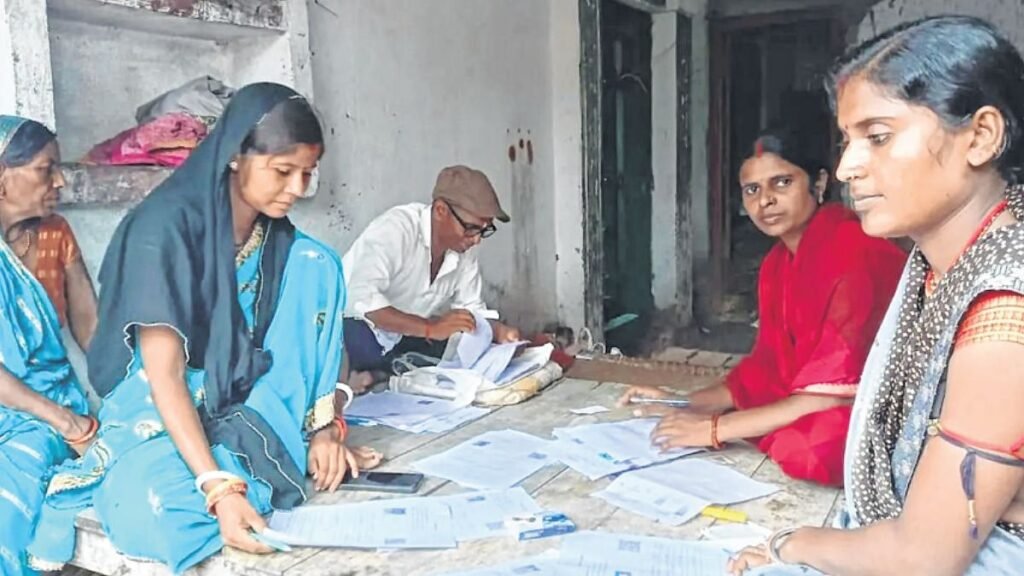
A detailed complaint filed before the National Human Rights Commission has described the SIR as imposing “inhuman workload and coercive pressure” on BLOs, resulting in deaths and collapses across states. It warns of a “moment of deep constitutional danger”—not just because workers are dying, but because voter deletions are happening alongside their deaths, unchecked, unaudited and unexamined.
The irony is brutal. The people tasked with protecting the vote are themselves dispensable.
BLOs are not full-time election staff. They are teachers, anganwadi workers and clerks—pulled from already strained systems and told to carry democracy on their backs without support.
The pressure does not stop at work. It leaks into homes. BLOs report threats of suspension, salary cuts and FIRs for “dereliction of duty”. Some face political pressure. Others face public anger. Many work in their own villages, vulnerable to backlash without security or institutional cover. The fear travels both ways.
Citizens panic when names vanish from rolls. In West Bengal, a 63-year-old rickshaw puller threw himself onto railway tracks after failing to find his name in old voter lists, losing a limb. The terror BLOs carry on clipboards becomes terror in homes. Bureaucratic rigidity breeds human collapse on both sides of the door.
At the heart of the crisis is speed. What was once a months-long exercise has been compressed into weeks. The so-called “Bihar model” of SIR has been imposed across diverse states without regard for language barriers, digital gaps, terrain or manpower. The system assumes infinite resilience from workers who are anything but.
Opposition leaders have called it “imposed oppression”. Unions call it “institutional murder”. Families call it abandonment.
The Election Commission insists the process is necessary. Necessary for whom? Necessary at what cost?
Democracy does not survive on forms alone. It survives on trust, dignity and human labour. When the state turns deadlines into weapons and manuals into shackles, the process may continue—but legitimacy bleeds out quietly, one BLO at a time.
Thirty-three dead so far is not a statistic. It is an indictment.
Every night, somewhere in India, a BLO stares at a phone screen that refuses to upload, a form that refuses to validate, a deadline that refuses to move. Somewhere, a child waits for a parent who is still “on duty”. Somewhere, a manual lies open at page 56, dense and indifferent.
And somewhere, democracy is being updated—by people it is slowly killing. If elections are the festival of democracy, then these are its unlit pyres.
The author is News Editor, The Free Press Journal.