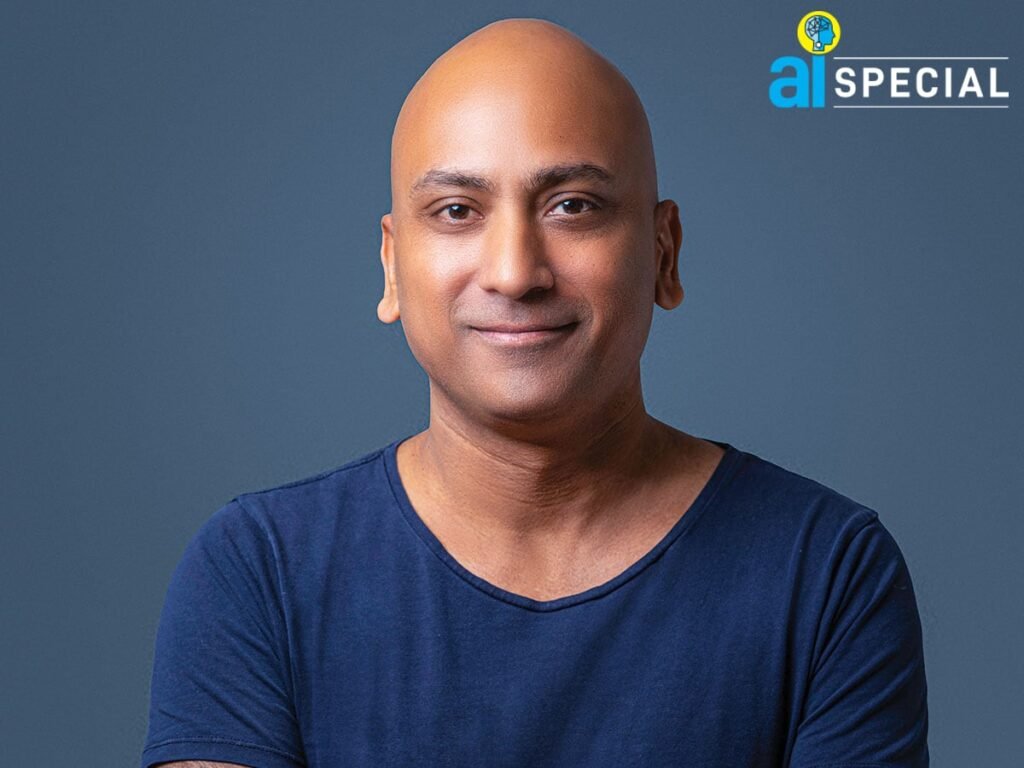



It began with a blinking cursor and a question. At the age of 12, Vipul Ved Prakash sat in the computer lab of Apeejay School in Noida, staring at a screen that would change the course of his life. The program he typed was simple, written in Basic, one of the earliest programming languages taught in schools. It asked, “What’s your name?” and, after a brief pause, responded with a personalised greeting: “Hi Vipul, how are you?”That moment, though modest in technical complexity, was profound in its emotional impact. “It still gives me goosebumps,” he recalls. The computer’s ability to respond with something that felt personal—even though he had written the code himself—sparked a lifelong fascination with the idea that machines could exhibit a form of intelligence.Today, Prakash, the founder of Together AI—a company that provides cloud computing services and software to nearly 500,000 AI developers and enterprises like Zoom and Quora to train, fine-tune and run AI models—is one of the most prominent figures in the AI revolution. Since its launch in 2022, the company has emerged as a major force in the open-source AI ecosystem, notably through its RedPajama-V2 dataset, which comprises over 30 trillion tokens and supports the training of large language models (LLMs). In February, Together AI raised $305 million in a Series B round led by General Catalyst, pushing its valuation to $3.3 billion, more than double what it was the previous year. According to Bloomberg, the company’s annualised revenue has surged past $100 million, up from $30 million just a year earlier.View the full list here Early DaysIn 1999, Prakash was among the first wave of internet users in India. As he began working extensively with email, he encountered a growing nuisance: Spam. “I ended up building an open-source collective intelligence system that allowed people who were receiving spam emails to report them,” he explains. The system would then block or filter those messages, preventing them from reaching other users. Within a year, over 10 million computers were running what became known as ‘Vipul’s Razor’. In 2001, he co-founded Cloudmark with Jordan Ritter to commercialise the technology. The company was later acquired by cybersecurity firm Proofpoint in 2017 for $110 million.In 2007, he launched Topsy Labs, a social media search and analytics company. “We built an indexing system from the ground up that indexed over a trillion social posts and was up-to-the-second real-time, sorting through the noise and fake news,” he says. Apple acquired Topsy in 2014 for $200 million, and Prakash stayed on as senior director till 2018.Also read: TogetherAI”s Vipul Ved Prakash: Democratising AI access with open-source solutionsBuilding Together AIIn early 2022, a paper from Google DeepMind caught Prakash’s attention it demonstrated how AI models could solve competitive programming problems, a domain traditionally reserved for some of the brightest human minds. Around the same time, OpenAI’s GPT-2 was gaining traction, and the momentum in generative AI was unmistakable. “We felt this was going to be something remarkable,” Prakash recalls. But there was a problem: Access. For many researchers, especially in academia, the infrastructure to train large models simply didn’t exist. “The cloud was built for CPU computing. GPU access was expensive and limited,” he explains.This gap became the founding insight behind Together AI, a platform designed to democratise access to GPU computing and empower developers and researchers globally to build both AI models and applications. What began as a mission to enable participation has since scaled into a formidable infrastructure company.While Together AI isn’t directly building data centres from scratch, they partner with companies that specialise in data centre infrastructure to meet their high-performance GPU cluster needs. Together AI’s business model leverages these strategic partnerships—ensuring rapid deployment and scalability. This approach lets them focus on optimising the software and systems aspects of AI acceleration, while relying on expert providers to handle the physical infrastructure layer.“We had long been strong believers in the open-source ecosystem, and what Vipul was building stood right at the intersection of open source, generative AI and distributed systems. It was a very early market, but the technical depth of the team and the clarity of their vision made it an easy decision for us to invest,” says Brandon Reeves, partner, Lux Capital, early investors in Together AI.Prakash’s vision for Together AI is grounded in a strong commitment to open source. “We want to be the platform that provides access to tier-one, open-source models,” he explains, “so people can build with them, fine-tune them, and deploy them however they want.” For Prakash, the stakes are clear: “This is the most important technology humans will build. And it’s a huge risk if the best models are closed and controlled by just one or two companies.”His long-term ambition reflects both scale and inclusivity: “We want to be the place where developers build and do research and then deploy their AI systems. We think it’s a massive market. The bulk of computing will be driven by AI models. So, we are building something that will happen at scale.”
TogetherAI's Vipul Ved Prakash: Democratising AI access with open-source solutions
📅 Published: November 20, 2025 |
📂 Category: Uncategorized